




License key management
Create, distribute and track keys with flexible expiration rules and usage limits.

LicenseKIT is a license management platform that lets you create, distribute and validate software licenses in real time, from desktop applications to SaaS products. With HWID locking, webhooks and analytics, the entire licensing process lives in a single panel.
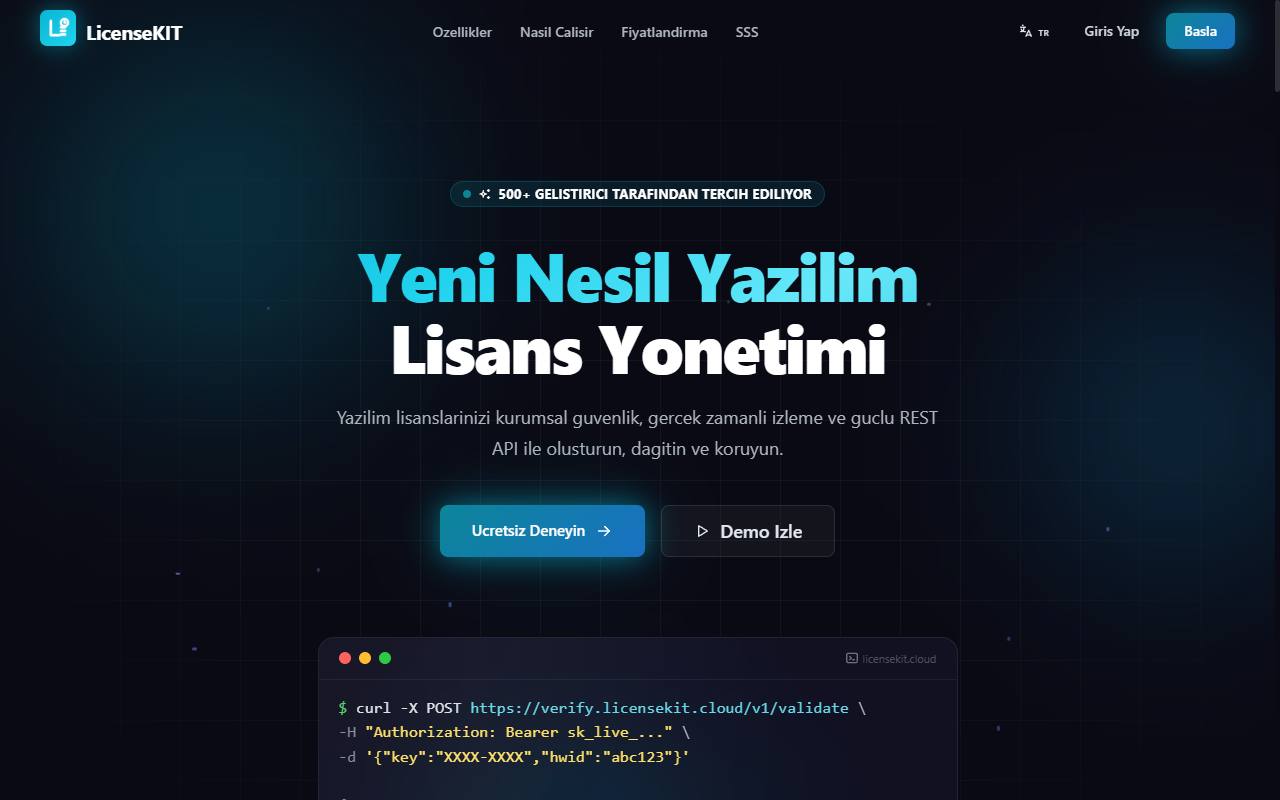
LicenseKIT is a license key management platform for software developers: define your products, generate keys with flexible duration and usage limits, and have your application validate over the REST API in under 50 ms on every launch. Licenses are bound to a hardware ID, activation events are delivered instantly via webhook, and integration takes minutes with the JavaScript and Python SDKs.
Define your software products; configure duration, usage limits and HWID rules.
Create license keys in bulk or one at a time with custom settings, and distribute them to your customers.
Let your application validate in real time via the API; monitor all activation and validation activity from the panel.
Create, distribute and track keys with flexible expiration rules and usage limits.
Bind licenses to specific hardware IDs to prevent unauthorized sharing.
Instant notifications for activation and validation events.
Track usage patterns with dashboards and gain insights.
A RESTful API that fits every technology stack; SDKs for JavaScript, Python and more.
Two-factor authentication and enterprise-grade encryption.
Let’s evaluate the user structure, integration needs and, if any, options to adapt it to your brand.
Software teams of any size that sell desktop applications, developer tools or SaaS products and want to keep their licenses under control.
The license is bound to the device’s hardware ID on first activation; when the same key is used on another device, validation is rejected or restricted according to your rules.
The REST API can be called from any language; ready-made SDKs are available for JavaScript and Python.
Yes; your existing license data is imported, and the migration is completed by switching the validation endpoint.